Performance management software

Reviews that actually happen.

Cycles that run themselves, templates you build once, and goals that stay visible between reviews instead of resurfacing the week before one.

Most review processes fail the same way. The cycle opens, a form goes round, two thirds of it comes back, the conversations that do happen are good, and then nothing is looked at again until next year - by which point the goals everyone agreed on have gone stale.

Teamli is performance management software built to close that gap. You build a template once, launch a cycle, and the system tracks who has completed what and nudges whoever is holding it up. Goals live outside the review form with their own owners and due dates, so "at risk" is something you find out in March rather than in December. And when a review turns into a genuine performance concern, it moves into a formal capability process with the evidence already in place.

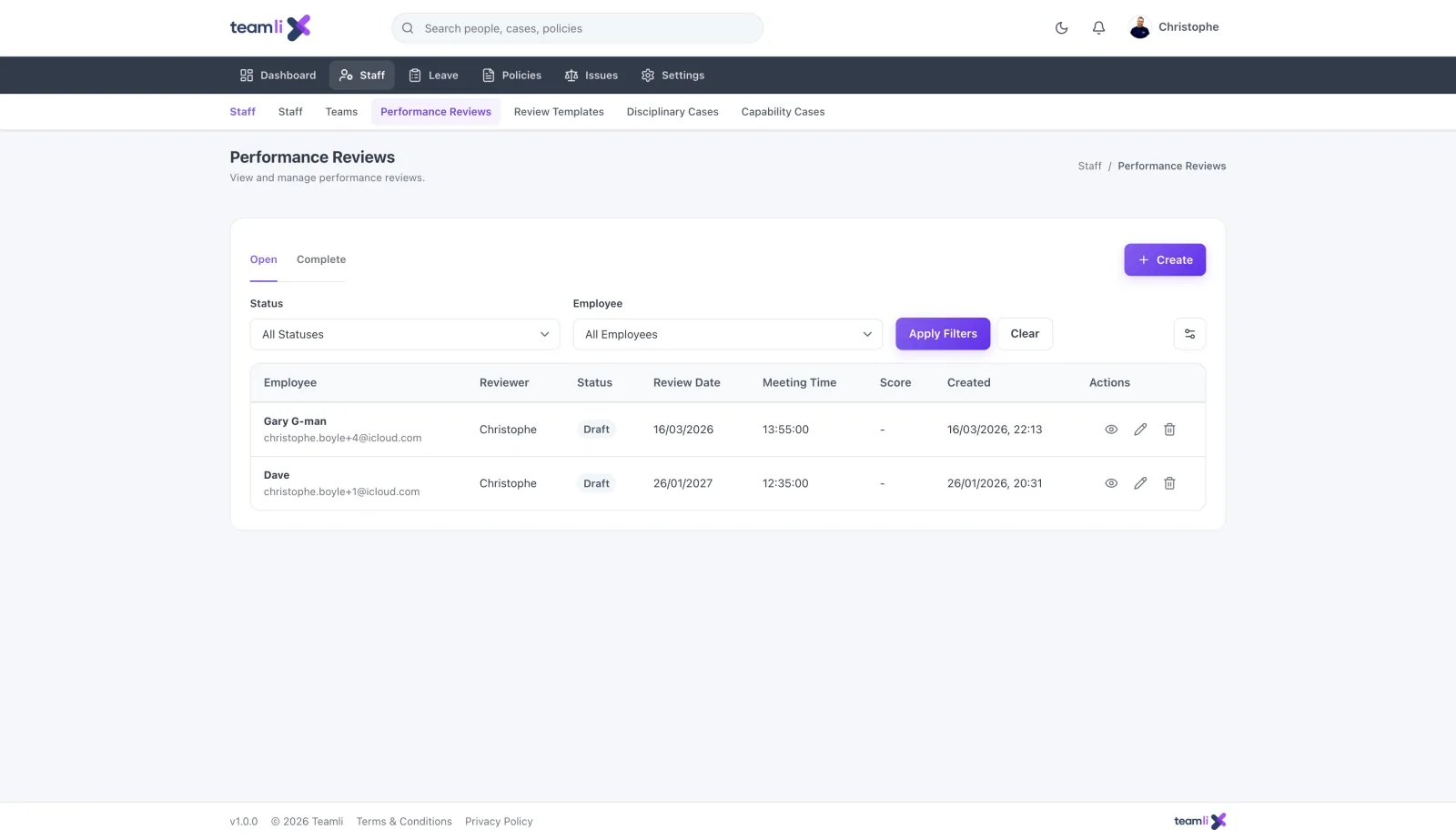
The Teamli performance reviews list, split into open and complete tabs, showing each employee's reviewer, status, review date, meeting time and score.

Everything a review cycle needs.

Structured where it helps, and out of the way during the conversation itself.

Review cycles

Run annual, quarterly, mid-cycle, probation, 360 or project reviews.

Review templates

Build a template once with sections and questions, reuse it every cycle.

Question types

Ratings, free text, yes/no, multi-select, goal progress and competency scoring.

Probation reviews

A probation cycle that ends in pass, extend or fail rather than a rating.

Goals

Objectives with owners, due dates, weighting and milestones.

Goal status

On track, at risk, achieved or not achieved - visible before the review, not after.

Competency frameworks

Define competencies, attach them to roles and score against the same anchors.

Peer feedback

Invite colleagues to contribute, and see who has submitted and who has declined.

Review meetings

Schedule the conversation itself, and record that it happened.

Development plans

Turn a review into actions with owners and dates instead of good intentions.

Manager & HR reports

Completion rates, overdue reviews, rating distribution and calibration gaps.

Automatic reminders

A daily nudge to whoever is holding a cycle up, so it lands on time.

Building the review your business actually runs

A template is sections and questions, and a question can be a rating, free text, a yes/no, a multi-select, a goal-progress check or a competency score. Attach competencies to roles so an engineer and an account manager are scored against the right anchors. Publish it, and it is there for every cycle that needs it - annual, quarterly, probation, 360 or a one-off project review.

Running the cycle without chasing

Launch a cycle and Teamli opens a review for everyone in scope, collects employee and manager responses, and gathers peer feedback where you have asked for it. The cycle itself moves through draft, active, in progress, calibration, finalizing and completed, and a daily reminder goes to whoever is holding it up. Managers see their team's completion; HR sees the whole organisation's.

Goals that survive the review

Objectives are recorded with an owner, a due date, optional weighting and milestones, then tracked as on track, at risk, achieved or not achieved. Because they sit outside the review form, progress is visible all year, and the next review starts from what actually happened rather than from memory. Development plans turn the conversation into actions with dates on them.

Knowing where the programme stands

Manager and HR reports show completion rates, overdue reviews, rating distribution and the calibration gaps that tell you two managers are scoring the same performance differently. It is the difference between believing the review process is working and being able to show it.

Performance management FAQs

What is performance management software?

Performance management software runs the review cycle end to end: it holds the template, opens a review for each employee, collects the employee and manager responses, records the conversation and the outcome, and tracks goals between cycles. Teamli does that without the spreadsheet of who has and has not filled their form in.

What types of review can we run?

Annual, quarterly, mid-cycle, probation, 360 and project reviews. Each cycle moves through draft, active, in progress, calibration, finalizing and completed, so you can see at a glance which stage the whole organisation is at rather than chasing individuals.

Can we build our own review forms?

Yes. A template is made of sections and questions, and a question can be a rating, free text, yes/no, multi-select, a goal-progress check or a competency score. Build the template once, publish it, and reuse it for every cycle that needs it.

How do probation reviews work?

A probation review uses the same template machinery but ends in a probation-specific outcome - pass, extend or fail - rather than a performance rating, so a new starter decision is recorded as the decision it actually is.

Does it handle goals between reviews?

Goals live on their own, not just inside a form. Each has an owner, a due date, optional weighting and milestones, and a status of not started, in progress, on track, at risk, achieved or not achieved. That means a goal going off track is visible in month three rather than at the review in month twelve.

Can colleagues give feedback?

Yes. Peer feedback can be requested as part of a review, and each request is tracked as pending, in progress, submitted or declined, so nobody is left waiting on input that was never going to arrive.

What happens if someone is not performing?

A review that surfaces a genuine performance problem can move into a formal capability process, with a performance improvement plan, goals and review dates. That is handled in case management, so the evidence trail carries across rather than starting from scratch.

Make the next review cycle the easy one.

Start your free trial and build your first template in an afternoon.