
Case management software

Difficult conversations, properly documented.

Disciplinary and capability cases with the meetings, evidence, outcomes and appeals held together in one file - and an audit trail you can stand behind.

Employee relations cases go wrong in the paperwork more often than in the decision. A meeting nobody minuted. An invite letter that lives in someone's sent items. A warning that expired eight months ago and is still being counted. HR case management software exists to stop that.

Teamli gives every case a file: what the concern is, who is involved, what was said in each meeting, what evidence was considered, what was decided and why. Disciplinary and capability run as separate processes, because they are separate processes. Anything that does not warrant a case at all can be logged as an issue instead, which is often where a problem is best resolved. And where a case starts with attendance, it connects to the sickness and return-to-work records that prompted it.

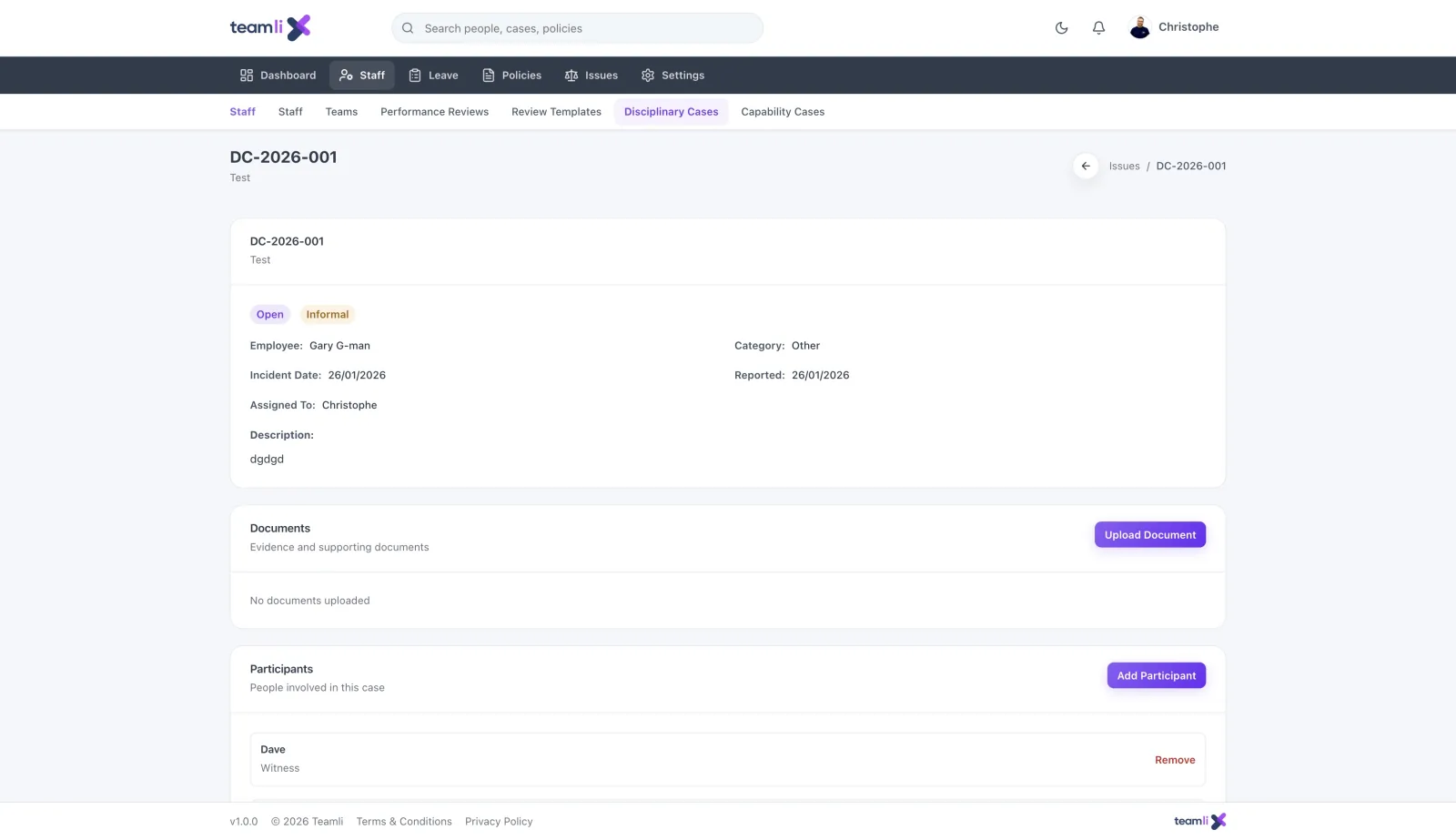
A Teamli disciplinary case file, showing its open and informal status, the employee, category and incident date, a documents section and the participants involved.

The whole case, in one place.

Structured enough to be consistent, flexible enough for the case in front of you.

Disciplinary cases

Misconduct, attendance, behaviour and policy breaches, each with its own file.

Capability cases

Quality, output, attendance and skills concerns handled as a separate process.

Informal or formal

Mark a case informal or formal so the right level of process applies from the start.

Case stages

Investigation, meeting scheduled, outcome pending, resolved - the status is never a guess.

Meetings

Investigations, disciplinary hearings, appeal hearings and reviews, scheduled and minuted.

Participants

Record the investigator, HR rep, witnesses, union rep or companion attached to each case.

Documents

Invite letters, evidence, statements and outcome letters stored against the case.

Outcomes

From no action through to dismissal, recorded with the reasoning behind it.

Sanctions

Verbal, first written, final written, suspension or dismissal, with expiry dates.

Appeals

Grounds, hearing, and whether the appeal was upheld, partially upheld or rejected.

Improvement plans

Capability cases can run a PIP with goals, review dates and a recorded result.

Full audit trail

Every action timestamped and attributed, which is what a tribunal will ask for.

Conduct: the disciplinary process

Open a case, categorise it - misconduct, attendance, behaviour or a policy breach - and mark it informal or formal. From there the status moves through investigation, meeting scheduled, meeting completed and outcome pending, so anyone picking the file up knows exactly where it sits. Invite letters, statements and evidence attach to the case, and the outcome is recorded with the sanction and its expiry date rather than living in somebody's memory.

Performance: the capability process

Capability cases record the performance area in question - quality, output, attendance, behaviour or skills - and can run a performance improvement plan from a reusable template. Goals get owners and review dates, progress is tracked against them, and the case closes as improved, not improved, or with an extended PIP. It is the same evidence trail as a disciplinary case, aimed at a different outcome.

Appeals, without starting again

An appeal attaches to the outcome it challenges, with its grounds on the record: procedural irregularity, new evidence, an unfair decision or an excessive sanction. The appeal hearing is scheduled like any other meeting, and the result - upheld, partially upheld, rejected or withdrawn - is stored against the original case, so the full history reads as one story.

Issues: everything that is not a case

Not every problem needs a formal process. Teamli has an internal issue tracker for the rest - a safety concern, a facilities problem, an HR question - with categories, priorities, an assigned owner and a comment trail. Issues can be raised anonymously, and they close with a recorded outcome, so a pattern is visible long before it becomes a case.

Case management FAQs

What is HR case management software?

HR case management software gives every disciplinary, capability or employee relations matter its own structured file - the allegations or concerns, the people involved, the meetings, the evidence, the outcome and any appeal. Teamli replaces the folder of Word documents and the email thread with one record that shows what happened, when, and who decided it.

Does it separate disciplinary and capability cases?

Yes, because they are different processes and conflating them is a common reason a decision falls apart. Disciplinary cases cover conduct - misconduct, attendance, behaviour and policy breaches. Capability cases cover performance and ability - quality, output, skills and attendance - and can run a performance improvement plan with goals and review dates attached.

Can we run an informal process?

Yes. Every case is marked informal or formal, so a quiet word can be recorded properly without dragging it through a formal hearing. If it needs to escalate later, the history is already there.

How are meetings and hearings recorded?

You can schedule investigations, disciplinary hearings, appeal hearings and review meetings against a case, record who attended and in what role - investigator, HR representative, witness, union rep or companion - and attach notes and documents to each one.

What outcomes and sanctions can be recorded?

Outcomes run from no action through verbal warning, written warning, final warning, suspension and dismissal, and for capability cases, improved, not improved or an extended PIP. Sanctions are recorded separately with their own expiry dates, so a warning that has lapsed is obvious.

Does it handle appeals?

Yes. An appeal is logged against the outcome with its grounds - procedural irregularity, new evidence, an unfair decision or an excessive sanction - then tracked through to a hearing and a result of upheld, partially upheld, rejected or withdrawn.

Who can see a case?

Access is controlled by role, so a case file is visible only to the people you authorise. Every view and action is written to the audit log, which matters when the records are this sensitive.

Stop running cases out of a folder.

Start your free trial and give every case a proper file.